
What is Net Energy Metering?
Solar systems work with the power company through a billing system called “Net Energy Metering” or NEM. This billing system allows you to receive credits on your power bill for the excess energy your solar system produces throughout the year. Those credits are then automatically applied to your power bill balance when you need them later — just like rollover minutes used to work on cell phone plans before we all got unlimited plans. Just like rollover minutes could not be cashed out, NEM credits can’t be cashed out either. The goal with a solar system is to install the number of panels that will produce as much power as you need in a year, not overproduce. Nobody profits from selling excess solar power to NV Energy. With NV Energy, you receive 75%* of the retail value for each excess kilowatt hour (kWh) you send back to the grid at the end of each billing cycle. Not kWh your system sends back — only the excess kWh at the end of the billing cycle. So, overbuilding your system is not in your financial best interest,
How do solar panels make power for your home?
Solar panels or modules are made up of photovoltaic (PV) cells. When sunlight hits the cells, it generates current and converts sunlight into power. Those solar panels’ direct current (DC) power is sent to an inverter. The inverter(s) do precisely what the name sounds like – they invert the current from DC to AC (alternating current) power, which is what your home uses. That inverted power is then sent to your main electric panel, where anything that uses power – like your dishwasher, the air conditioner, your kid’s video game system, or your TV – will draw it from the solar panels first.
If your system is making MORE power than you need, those excess kWh get sent back to NV Energy’s grid through your meter. They are immediately sold to the nearest building that needs power.
If your system is making LESS power than you need, you’ll get that power from the main power grid.
Everything in your home that runs on power will run exactly as it does now. Your air conditioner can’t tell the difference between running on dirty power versus clean kWh, but your power bill and your lungs sure can! Unlike fossil fuels, solar power doesn’t make noise or pollute air or water with coal ash or smog. Your home will also gain value as you now have a power plant on the roof that runs on unlimited free fuel. No more rising utility rates for you! With Net Metering, the extra power you make in the spring, fall, and winter pays for the more considerable power demand in the summer. In the Spring, Winter, and Fall, we have a lot of clear, sunny days. Most of us are not using our air conditioners, so our power use is way down. During those months, your solar system will usually make more power than your house needs. Your meter will “spin backward,” and you’ll be banking up credits against your future power bills — just like a squirrel would be stashing nuts for the winter. When summer rolls around, and the temperature soars, you’ll need more power than your solar is making. NV Energy will then apply your banked NEM credits to pay for the extra power you use before calculating what is owed. Thanks to Net Metering, if we can replace all your power needs with solar, you could have an average power bill of about $19 a month year-round.
What does Net Metering look like on your NV Energy Bill?
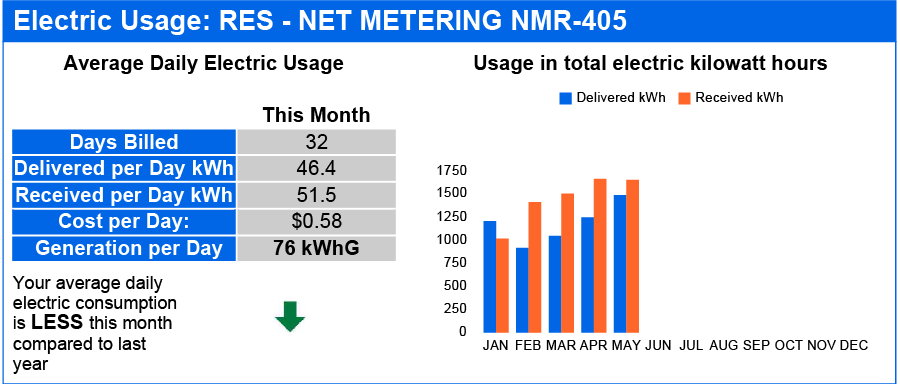
See the orange bars on the graph? That is excess solar production your system made, but you didn’t need it right then, so it was sent back to the NV Energy grid. On your bill, these kWh are labeled kilowatt hours received (KWHR).
See the blue bars? That’s power consumption where your solar wasn’t making as much power as you needed. Maybe because it was dark outside or cloudy, or maybe just because it was hot that day and your AC was running. On your bill, these kWh are labeled kilowatt hours delivered (KWHD).
At the end of every billing cycle, NV Energy settles with you.
The formula is: KWHD minus KWHR = Kilowatt Hours Accumulated (KWHA) or Kilowatt Hours Net (KWHN)
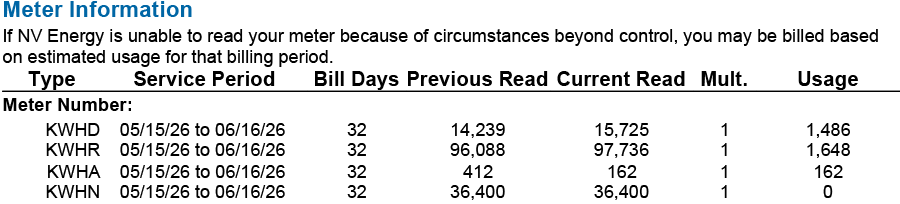
On the bill shown above
1,486 KWHD – 1,648 KWHR = 162 KWHA
The power you send back to the grid (KWHR) wipes out the power you used from the grid (KWHD) on a 1-for-1 basis. You receive 75% of retail for the EXCESS power (KWHA), not for every kWh your solar makes.
You can see how the bank is doing by looking at this section of your bill:
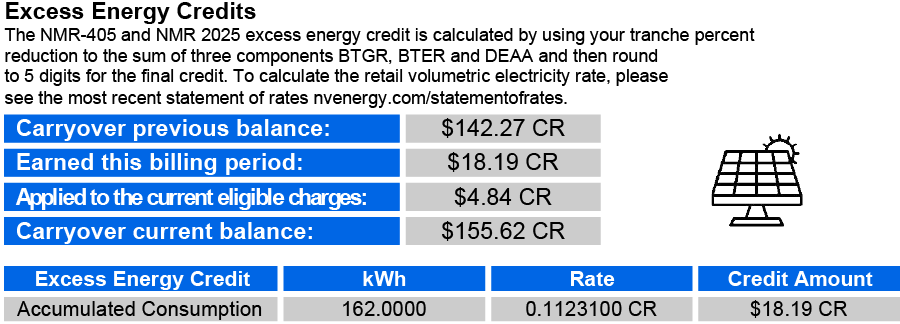
At the beginning of the cycle, there was $142.27 net metering credit in the bank.
They added a $18.19 credit for the 162 KWHA this billing cycle.
They removed $4.84 in credit to pay for taxes and fees that can be offset with solar.
Leaving $155.62 credit in the bank.
So how much was the total power bill for the May-June bill with solar on this home?
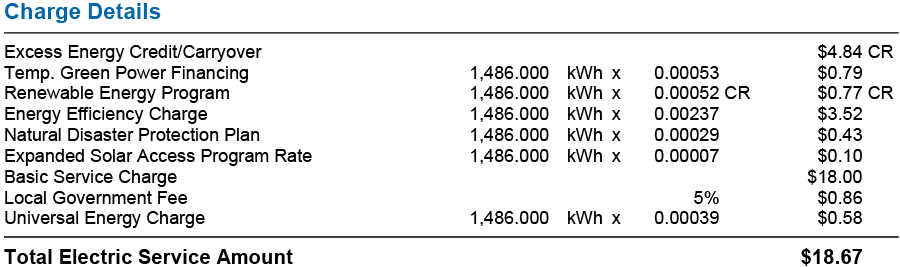
It was only $18.67! Once your system is on, you will still have to pay the basic connection charge, which is $18, plus any other non-bypassable taxes, fees, or charges. Right now, there is roughly $0.50 to $1 dollar in taxes and fees that cannot be wiped out with Solar, even on a month when you bank up credits like this one. In January of 2027, NV Energy will add a non-bypassable daily demand charge that cannot be wiped out with NEM credits.
This system was installed in 2018, so it is on Tier Net Metering at 95% of retail. Systems installed after 2020 are all on Tier 4 and receive 75% of retail. The difference between 95% credit and 75% credit sounds like a lot, but it is less than $100 a year for most folks. Why is that? Remember, you only receive KWHA at the end of each billing cycle, not for every kilowatt-hour your system makes or every kilowatt-hour you send back to the grid. The average-size system in Las Vegas generates about 2,500 kWh each year.
At 95% of retail on Tier 1: 2500 x .1121 = $280.25 NEM credit
On 75% of retail Tier 4= 2500 x .0885 = $221.25 NEM credit
A $59 difference.
What if I add on to an older system? Do I lose my NEM Tier?
Yes. The entire system will move to Tier 4 at 75% of retail. That sounds bad, but again, if you are adding onto an older system, that means your system was not producing much (if any) excess power to convert into KWHA. Even in the spring and fall months, you probably had KWHN most of the time instead of KWHA. So, you are losing 95% of almost nothing. The expanded system will finally generate KWHA in those Spring and Fall months, so you’ll see credits on your bills instead of paying most months.
*If the system size is over 25kw, you will receive 100% of retail value on the NMR-B rate.